Showing posts with label shows. Show all posts

Nov 16, 2017

Artistic Arsenals...

This is a long lecture, but still an interesting take on the methods, materials, and tools used painters throughout the ages, largely centering on the Old Masters. 

I've always been interested in the way painters can do so much with so little. So if you have 90 minutes or so to watch this video you will likely learn and few things about your chosen craft.

I, for one, wasn't aware that until the mid-19th century, European painters (and thus American painters by default, as well) only had about twenty five colors at their service, with only eight of them being mineral in content. This means the bulk of the colors they had available to work with were somewhat fugative. 

Compared to all the colorants we have today, it is remarkable what could be accomplished.

Think about that the next time you visit your local art store, or order paint online!

Enjoy!


Jun 27, 2017

Info on Sargent's Watercolor Technique...

Sargent Watercolor Show Review

JSS_Faces_02

John Singer Sargent Watercolors: Exhibition Report
 We recently visited the Brooklyn Museum to see the show of John Singer Sargent watercolors. It’s close enough to Montreal that I couldn’t really pass it up. Not and still call myself a serious watercolorist. The exhibit ends July 28, so by the time I post this it’s basically over – however, it comes to the MFA in Boston (Oct 13/13 – Jan 20/14), so that’s another chance for Nor’easterners.
Like most artists, I’ve always admired Sargent’s mastery of calligraphic brushwork in oil. I wasn’t as aware of his watercolors before this show. Which I suppose was the point. The curators have brought together a never-before-seen exhibit. 
So, for those that don’t have a chance to get there in person – here’s my report...

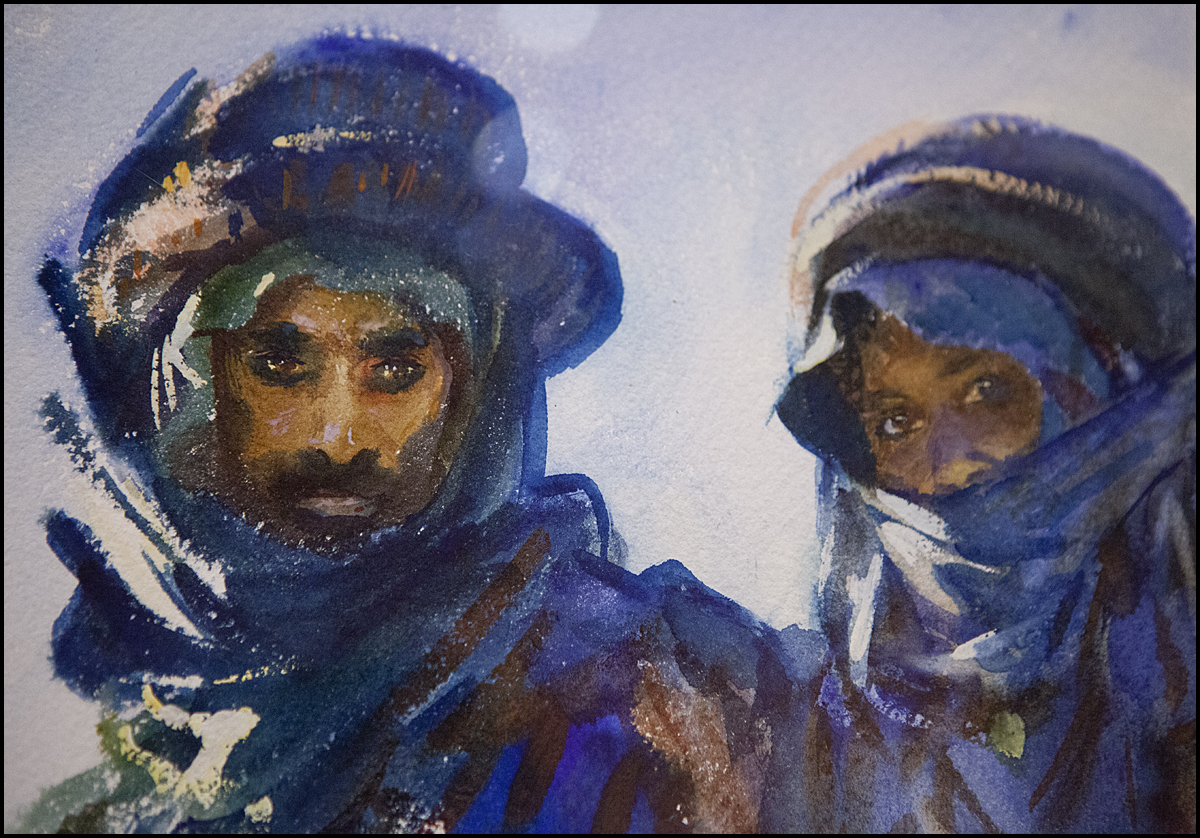
I don't often cross-link to another writer's blog, but here is a link to a fascinating post about Sargent's watercolors. The author, Marc Taro Homes, author of The Urban Sketchbook, took some lovely close ups of JSS's watercolors in the Brooklyn Museum, and his observations with regards to Sargent's use of gouache on top of watercolor and other effects are quite illuminating.

So visit his blog page here and learn something new about Sargent's technique...


It looks like I'll be in Boston next October while this show is there so I'll add to Marc's report when I see it.

Enjoy!

TJK

May 16, 2017

Los Pequeños Dibujos de Sorolla... (The Little Sketches of Sorolla)


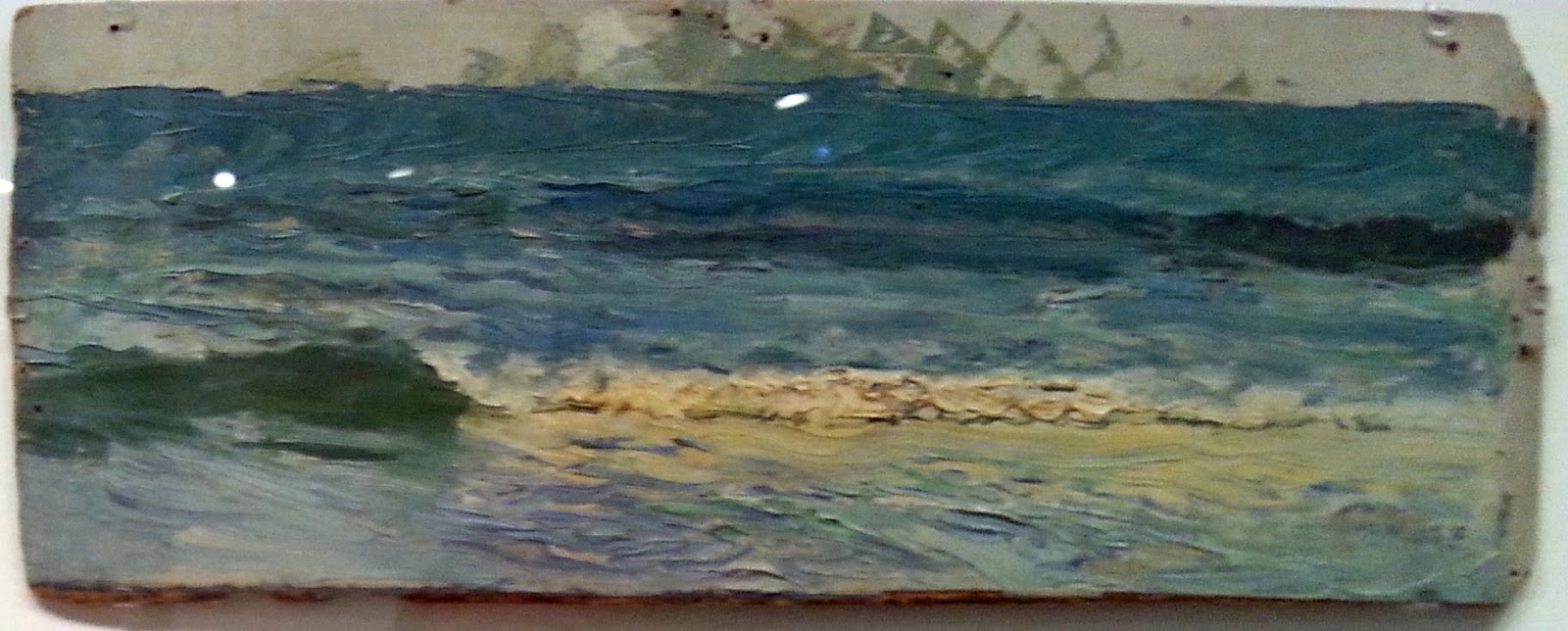
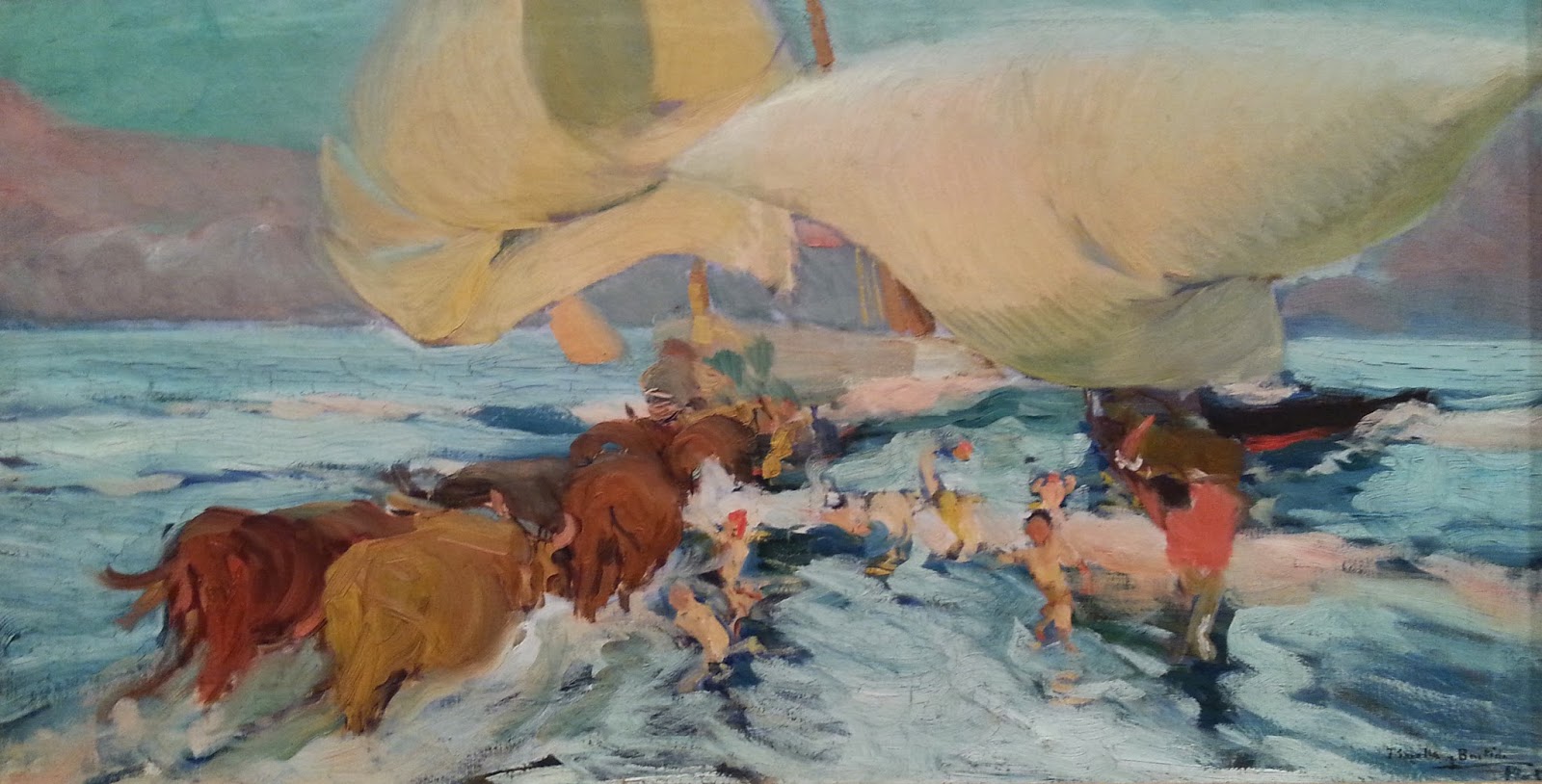
Los Pequeños Cuadros... Fernando, a good friend of mine visited the Museo Sorolla in Madrid back in 2014, and while he was there he photographed some of the hundreds of color sketches Sorolla executed to keep his hand busy. (I just found the jpgs Fernando sent to me four years ago.) The little paintings you will find below are now hung behind a large glass case in Sorolla's main working studio and many of them have never appeared in print. Some were clearly experimental explorations, and some of them were preparatory designs for larger work you can recognize. In any case, to spend time with these little goodies is revelatory and worth a trip to the Sorolla Museum alone.

And no, I don't have titles for any of them. In truth, I doubt there were titles since it would be unlikely that Sorolla thought of them as finished work. I remember most of these colorful sketches being thickly painted on cheap brown chip board, and sized quite modestly between 4 x 5 to 8 x 12 inches or so, with a few of them being a bit larger.

Okay, mental note to self: Start doing quick little studies!...

Enjoy!...


(click images to enlarge)


Dec 1, 2015

A Quick Reminder: My Portland, Oregon Exhibition Opens this Week...


Hey All: Here is a reminder if you are in the Portland, Oregon area this week... My first (public) hometown exhibition in over twenty years is now going up on the wall today. 

The show officially opens this Thursday, Dec. 3rd, and there will be an ARTIST'S RECEPTION Friday December. 4th – starting at 5:00 pm at Brian Marki Fine Arts. (Details can be found on the invite below.)
I look forward to seeing you there!...


Nov 30, 2015

Yaquina Waters, on the Coast near Newport, Oregon...

During Thanksgiving, in late November, we had glorious weather on the Oregon Coast. Here is a short video of how I spent the afternoon.

Enjoy!...


Jul 30, 2015

New Landscapes: From Carmel to Big Sur...


Well, my new show is now up on the walls at the
James J. Rieser Fine Art gallery in Carmel, California. 

This show of thirteen paintings opens this Saturday, August 1st, but I am confident if you want to preview the work before the official opening James would be happy to accommodate you. 
Rieser Fine Art is conveniently located between 5th and 6th, on Dolores Avenue, and it is also nicely situated next door to the Jack London Pub, my favorite watering hole. (ha!) 
If you see something you like, and want to jump the opening with a purchase, I'm sure James would be happy to help you out with that. Just let him know I sent you.
I will be flying down August 8th for an artist reception, which will be held from noon to 4:00 pm. So hey, if you are going to be in the area come by. I'd love to see you!

"New Landscapes: From Carmel to Big Sur" will be up until September 30th, 2015.

Can't attend the show? View the paintings here: www.rieserfineart.com


Apr 20, 2015

The 2015 Plein Air Convention & Expo...


Well, that was fun. 

Last week consisted of a flashmob of around eight hundred plein air painters – accompanied by a host of seasoned pros, supported by a professional staff intent upon keeping things moving along, and lots of energy in the lecture rooms and out in the field. 


Last week was the 4th Annual Plein Air Convention & Expo (PACE), in Monterey, California, and from my perspective, it was the best one yet. Every year the organizers work hard to raise the bar based upon the feedback they get from the previous year. In fact, the only complaint I heard this year came from a participant who said, "Geez, there are just too many things on the schedule to get to them all!" – which is a nice problem to have. And really, the person who shared that didn't seem all that upset.


As expected, there were a lot of first-timers and newbies in the crowd, ranging from those who had never picked up a brush before to those who had some experience painting outside but were struggling. There were also a lot of intermediate to experienced painters as well. Yet the show agenda was designed to serve all levels and by and large everyone's expectations were met. Maybe one or two people went home unhappy, but if so – well, you can lay the banquet but you can't make everyone eat. 


The demos were well-presented, the talks engaging, most medias were covered, and afterhours fraternizing was encouraged. It was an open, inclusive, and informative event for all.


If I were to try and convey the spirit of this year's convention I'd liken it to the medieval tradition of Kermes, a yearly ritual where everybody in the village gathers together from the King on down to celebrate the advent of Spring. (Oh, Spring, the annual rebirth of the world and what every outdoor painter eagerly anticipates, yes? Especially those of us up north this year!...) A festival time when the planting was celebrated, barriers came down, and people would feast and dance late into the dark. A sort of ancient let's all get down and boogie. Where else will you see the superstars and unknowns of an artistic genre hang out until the wee hours of dawn to talk and laugh together? And then get up to do it again the next day?


There were a few bumps and hiccups, of course. But nothing worth mentioning beyond that. Nothing you shouldn't expect or even embrace during such a large and free-wheeling event as PACE. If you knock off all the corners you are likely to end up with too much polish...


Sure, the cost of admission is high, and perhaps that makes the event a no-go for some folks. Every year there is a call for an alla carte format but I can't see how offering the experience in bits and pieces could work logistically. PACE is an all-in sort of event and frankly, therein lies most of its charm. PACE sets out a giant smörgåsbord of art so if the only thing you want to eat are chicken wings and pizza-by-the-slice then perhaps you shouldn't go. But if you are the kind of person who noshes widely, or someone hoping to take a series of workshops from different master painters over the next few years, then attending a PACE permits you to meet and evaluate many of the best instructors in the business – in one week, in one place – for about what you'd pay for a single workshop. Plus, you can evaluate a potential teacher's interpersonal and communication skills face-to-face, which can be invaluable before you plunk your money down.


The plein air world has always leaned towards inclusion. Because at its core it is a democratic genre. It is also, in other ways, a self-policing meritocracy, and it attracts like-minded people who enjoy painting outdoors together. Not every plein air painter wants to buddy-up, of course, but the general principles of the genre encourage camaraderie and fellowship and the submission of your ego to a thing larger than yourself. So conceit is harder to find in the plein air world and that fact showed at PACE. You could talk to anyone.


After all, where else can you paint next to an artist you've venerated for years only to crash and burn your painting? And then turn to to your left to see they have crash and burned theirs too? (Oh, that 50 mph wind at Asilomar...ha!) 

Where else can you go to meet other members of your tribe? Where else can you be called an 'art-dork' have it feel like a compliment? (I'm looking at you, S...ha!) Where else can you go to meet people from all over the world, make new friends, and create opportunities to paint in places you've never been?


Next year, PACE will be held in Tucson, Arizona. After three years in Monterey, California, the Southwest is the next venue. So get ready to go. There may be some picante twists added into the mix for 2016 but you can expect it will still be a moveable feast...


____

Would you like to improve your outdoor painting skills in Italy this September? If so, click here to learn about my Plein air Tuscany! workshop.

Or send me an email and request a FAQ Sheet and Trip Itinerary. They will detail where we will stay, what we will do, what we will learn, and of course, what it costs. But wow, the US dollar is now stronger than the Euro so there may never be a better time to go than in 2015. 

Registration is open and folks are signing up!... (Now just six spots left.)


Mar 9, 2015

Making Your Own High Quality Plein Air Panels...


I am off to go paint in the Californian desert tomorrow morning before opening a group show in Palm Springs and I got caught short on ordering some plein air panels. (So busy, in and out, in and out. Doh!...) So I had to make some panels Saturday afternoon for this trip. Since I keep the necessary materials around for such an emergency I can make panels at a moment's notice. But usually if I have enough turn-around time I order them from my favorite suppliers. I don't find the cost-savings of making them to be enough of a motivation to do it regularly...

But hey, if if you are pinched for time like I was, here is a quick walk through. The key to doing this easily is in the adhesive.

The Materials You Need: 

1. For small panels, 1/8 or 3/16 inch hardboard (often called Masonite™). Tempered or untempered is fine. At least one side must be smooth.

2. Some pre-primed linen (For these panels I used the remainder from a 6 yard x 64 inch roll of double-primed Claussen's linen purchase at 50% off using a coupon from my local art store. A steal...) 

3. The secret ingredient: Dap Water-based Weldwood low VOC Contact Cement. (Recommended to me by Karl Bostwick last year and I have found it to easy to apply and works well in the field. I have not experienced any edges lifting or panels warping as of yet.) 

4. Disposable foam roller and shallow paint pan. 

5. Brayer or acrylic roller.

6. Sharp carpet knife. 

All told, if I disregard the time it takes to go to the hardware store to get the hardboard the shop time ran about one hour.


The Process: 

1. Cut the hardboard to desired panel size. Wipe or blow any dust off the surface you will apply to the adhesive on, meaning the hardboard and linen. Use a smooth side of the hardboard for the adhesive.

2. Cut your linen 1/2 inch over sized because it will shrink immediately after applying the water-based adhesive (Canvas shrinks will as well but not as much.). 

3. Use a disposable surface under the masonite and the linen when rolling on the adhesive because glue will drip and overrun the edges. I keep scraps of foam core around for this reason. Roll the contact cement on to both the board and the linen and let dry to the touch (about 30 minutes). Read the can for more detailed instruction.

The linen sheets will curl aggressively as the adhesive dries so keep a close eye on them. Once the curling begins gently flip the sheets over to prevent them from rolling up entirely. (If you don't do this they will roll up like papyrus.) Don't press the linen into to the surface, just let the corners raise the  sheet and this will keep anything from bonding.

4. Once the board and linen is dry to the touch, flip the linen back over (meaning, the primed-side should now be down) and carefully position the top corners of the hardboard panel inside the top and sides of the linen sheet. The corners will grab each other. Confirm there will be excess fabric beyond the edges before laying the board down on the linen. Take care with your alignment because you will not get a second chance to reposition things. 

5. Gently press the two pieces together and flip the combo over again. Use a roller on the primed side of to securely bond both the fabric and board together. Push the brayer from the center to the edges so any stretching of the linen will be uniform. 

6. Stack your panels in a neat pile and place a weight on it (That is what the Utrecht bucket of gesso in the photo was used for... Again, I was using pre-primed linen here.) 

7. After a couple of hours, flip the panels face down and use firm pressure to trim the excess fabric off the edges of the panel with a sharp carpet knife or x-acto blade. You can use the edge of the panel as a cutting guide, but please, keep an eye on your fingers. I've seen folks cut themselves pretty badly because they weren't paying enough attention and their knife slipped or jumped the edge. Do NOT cut in a direction that takes the knife across your body. Keep the direction of your cuts towards the outside of your body. If you were once a Boy Scout then you know what I mean.

8. Flip the panels over one last time and rub off any contact cement that may have gotten onto the front of your painting panel with your finger, and VOILA, you are done!

While this will be cheaper than purchasing quality commercial plein air panels making them yourself requires time and effort and you should remember that the time you aren't actually painting is worth something too. Personally I'd rather spend my time pushing paint around than making panels so I prefer buy my panels unless I am caught short as I was this weekend. And this really isn't a kitchen tabletop project unless you happen to live alone and don't mind messing up the table. Making your own panels becomes a convenience only if you make do a large batch at a time or you prefer to paint on a surface you can't get elsewhere. If I had to guess, the 9 x 12s you see here cost me about $2 to $2.50 each, but that is a rough estimate.

If you prefer using lightweight Gatorboard™ as your substrate the adhesive should work on it as well.

Of course, if you don't want to make your own high quality plein air panels you can find some here:


I am off to the low desert next!... Follow me on my Facebook page if you wish...


____


Would you like to improve your outdoor painting skills in Italy this next September? If so, click here to learn about my annual Plein air Tuscany! workshop. It is a fantastic experience and garners rave reviews! 

If you want even more info send me an email asking for a FAQ Sheet. It will detail where we will stay, what we will do, what we will learn, and of course, what it will cost. But wow, the US dollar is strong against the Euro right now so there may never be a better year to go than in 2015. Registration is open and folks ARE signing up!... (Seven spots left!)

Aug 13, 2014

PleinAir Today and OutdoorPainter.com Offers Tips on Painting in Tuscany...


...Based upon my recent trip to Italy last May.


If you would like to read the full article online click here...

If you would like to read a downloadable and printable
pdf copy of the article click here...

If you would like to see Most of the painting 
from my trip in greater detail click here...


As the author Bob Bahr mentions at the outset of his article, I have already agreed to teach in Tuscany again in September 2015. The experience was so good, so fun, and so rewarding for everyone who participated, how could I say no? 

Next year could include you!

So, if you would like to join me one year from now, and work on your plein air painting skills under the Tuscan sun then click here and place yourself on the early notification list. 

Those who do will receive the details this October!

– TJK –


And don't forget, if you want to know who is who, or what is going on in the plein air world, consider subscribing to PleinAir Magazine!


Mar 5, 2014

I am back from the Maui Plein Air Painting Invitational...

…and boy, was it was a difficult week.


Obviously, I am not complaining, because hey, it was Maui in February and I got to paint in the sun. 

But still, it was a difficult week.

The weather started off well on the first day but stopped cooperating on day two and then kept fussing about until the day before we turned our paintings in. There was the vog, there was the overcast, there was the rain. And early in the week there was some unexpected transportation problems. On top of all that, on Monday I lost my wallet somewhere on the island and found myself without cash or credit cards. Reduced to bumming rides from fellow painters while I waited for replacements.

So as mentioned – a difficult week. 

But hey, let me repeat: I was on Maui, surrounded by friends, and there to paint – not to mope or complain. My problems were of the first-world order, and in paradise to boot, so it was important to keep telling myself that!

I think the best thing about doing these events is the caliber of the people you meet. Our fellow painters, the event organizers, our hosts, and the collectors and general on-lookers who get excited about what we do. I don't think this changes from place to place. It seems to be the same everywhere I go. I can't say what the experience is like in other genres of art but the plein air milieu is filled with folks who just want to help. Even a cashless, cardless, (and now carless) artist freaked out about how to get from point A to point B without becoming a drag. But it turned out I had to decline more rides and offers of assistance than was needed to accept and that was a moving moment for me. Kindness teaches a lesson. So thank you Ned, Mary, Keith, Barbara and Wally, Pierre, Jenny, Jeanne, and everyone else who lent a hand. Without you the week would have been worse. I not only owe you, I want to pass it on.

As I keep saying – it is Maui. A place filled with the Aloha Spirit, a way of life that goes beyond greeting someone with hello and goodbye. After all, how bad could things get in paradise? I may have felt penniless and temporarily itinerant (and in truth I was neither) but this experience helped me refocus on what is truly important. Painting. I am grateful and humbled by that.

So the big lesson for me last week was: When life give you a bunch of lemons break out the cadmium yellow light. 

________

Here is most of the work I produced on Maui. It's kind of funny. I intended to just paint a few – maybe as many as five – and really work each piece to a more finished state, as I have recently been doing at other events. But somehow this time the numbers got away from me. Didn't even realize what I was doing. While I'm not crazy about everything I produced these are the ones I am most happy with...


Serenity
12 x 16 oil on panel
Currently at the Village Gallery, Lahaina Maui
Available

Sorry about the crappy iPhone copy shot. It was our opening event of the week and I barely remembered to take a snapshot during the three hour paint out. The Jodo Mission Buddha is the largest sitting Buddha in the US as far as I know. It has a greenish cast which reflects all sorts of interesting colors from whatever is around it and the contra jour illumination interested me. I want to come back and paint it again at a larger scale. Little did I know as I painted this that I'd be needing a little serenity myself. The irony doesn't escape me.


Lahaina Harbor Rain
12 x 16 oil on panel
Currently at the Village Gallery, Lahaina Maui
Available

Painted during a rainy afternoon while waiting for my friends to come back from a whale watching tour. I would never have purposely chosen this as a subject but it turned out to be one of my favorite paintings of the week. I liked it so much I came back to this same spot for the QuickDraw at the end of the week.


Honokohau Church, Maui
12 x 16 oil on panel
Currently at the Village Gallery, Lahaina Maui
Available

I rode out to this church with Ned Mueller and we painted it between breaks in the rain. It is on the Kahekili Highway north of the Kaanapali/Kapalua areas and feels like the old Hawaii, before development. The narrow two lane road turns into a narrower single lane, with hairpin turns, no guard rails, and 500 to 1000 foot drops into the ocean below. So it's a good idea for the passenger to act as a spotter, anticipating any car coming from the other direction. Pull-outs and pass-bys are few and far in between the curves so someone must back up until the other can get by. If you have ever driven this road then you know what I am talking about…


The Jodo Mission from a Distance
12 x 16 oil on panel
Available

The Jodo Mission is an interesting place to paint. Located towards the northern end of Lahaina, it offers a refuge from the intense activity of the town. I like painting there for the quiet atmosphere. This is an unusual view of the pagoda, largely unnoticed and seen from the backside of Mala Harbor.


Lanai Sunset
8 x 16 oil on panel

When I arrived the 'Vog' had settled in to create the oddest light I have ever tried to paint. The vog erupts out of the volcanos on the main island and when it blows in it tints everything pink and gray. (Believe it or not, the sun is setting directly behind the cloud cap in the center of the painting. Pink and gray is not the usual palette you find in Hawaiian art but that is what was there. Sometimes I can be an idiot with my painting titles. I identified this painting as 'Molokai Sunset' on the opening night. When a kindly local corrected me I re-wrote out the title card somewhat embarrassed. It's important to get the islands right because someone will notice.


Hide-a-Way
12 x 16 oil on panel
Available

Green. Green. Green. Maui is green. Especially after all the rain they had before we showed up. I'm from the Pacific Northwest – you know, the wet part, so you can either choose to paint it as you see it, or gray the greens down. I painted them as they are. Ned Mueller, Colin Page, David Santillanes, and Hai-Ou and I drove up into Olowalu Canyon, past the general store, past the 300 year old petroglyphs, to this hidden spot. And we had to contend with the clouds coming and going all afternoon, which is Nature's way of toying with the plein air painter. David's version garnered the People's Choice Award. It was well deserved.


Luau Girl
12 x 16 oil on panel

This was from the Wednesday evening 505 Sunset Paint Out. Each year we've had a figure come out and strike a pose while the sun sets. In this case it was a young Luau dancer waiting for a performance that night, and she chose to stand between the front bows of a wooden outrigger. I'm not that crazy about this painting, or the composition and cropping I chose, and in no way do I think of it as a complete artistic thought. But I am sharing it with you so you can see how I often start a painting, by blocking out the major planes with warm and cool passages, and then looking to refine the shapes and soften the edges as I go. My original plan was to use the dancer's profile as my area of focus because it was so awesome in the side light, and then work more loosely out from there, but well, I ran out of time. She had to go dance down the beach. I also painted this on a dry cobalt purple ground that sucked all the oil out of my paint like a sponge. Seemed like a good thing to try at the time but I won't be doing it again. Ever. (ha!)


The Back of Front (Lahaina)
16 x 12 oil on panel
Available at the Village Gallery, Lahaina, Maui

This is my other favorite painting of the week. On Wednesday afternoon the sun came out for good and I was alone so I wasn't distracted. It was just me, the sun, and the painting. And hordes of tourists constantly passing by along the seawall. (Such is the life of the urban plein air painter…) However, there was amazing contrast between the lights and darks looking towards the south, and yet the color remained strong, so I had to paint it. We are essentially looking into the sun as it is dropping into the upper right corner, which is why the sky is so light. This is what happens when you look into the sun in the tropics. What you think is blue sky, isn't. Even though there can be a lot of blue reflected into the water. And shallow water being what it is, if clear like this was, you start seeing into it as it comes up to you in the foreground. That blue to green, contrasted by the reddish wet sand, was like crack cocaine for me. It had to go down.


The Beach at Kapalua Bay
12 x 16 oil on panel
Available at the Village Gallery, Lahaina, Maui

This beach is as about as Hawaiian as it gets on Maui. It is public sandy crescent  with shade and services, and the kids can wade into the water line all day long while parents can lounge or snorkel the reefs immediately offshore. When I take a dip I always encountering turtles in the murky wash, and once a spotted eel came up to my face mask unexpectedly. (Not an experience I wish to have again. All I remember of that moment was a circle of fine teeth pointing inwards with a big hole in the middle.) This painting is so impressionistic because I wanted to play with little daubs of color, with the idea that the image will pull together if you stand back. Dang, those French knew what they were doing!


Lahaina Harbor Morning (The Friday QuickDraw)
16 x 12 oil on panel
Available at the Village Gallery, Lahaina, Maui

Yes, the harbor again, but this time in sunlight. For those who may not know, a QuickDraw is a bit like the TV show, 'The Iron Chef'. They both contain an aspect of contrived competitiveness, and to a degree some showmanship. All of us artists are expected to set up in a small confined and very public area, in this case the harbor itself, and knock out a finished piece within a short period of time. We may paint at any size we wish but it must be complete before the horn goes off. In this case we had two hours. Then, after the horn we must tear down and pack everything up, and frame our quickdraw before bringing it to the gallery to be hung for the Gala show later that evening. No worries, no stress, right? It's kind of a publicity stunt and everyone tries to have fun while doing it. I try to execute all my plein air work as if they are quick draws, so standing in the middle of a curious public mob and fielding questions or wise-cracks and working at a fast clip is no big deal. It makes doing stand-up comedy in a club look easy except I'm not funny. (heh!)  I think all the quickdraws I've done are largely responsible for the improvement I've seen in my own work over the past five years. So I like doing them and specifically encourage my workshop students to paint fast and furious too – and if necessary – not to worry about picking up the pieces afterwards. After all, no matter how good or bad a painting may turn out it's still just a painting. You can let it go and move on to the next one without beating yourself up about it.


Facebookers and anyone else unable to view this video: click here!

I want to thank all the event organizers and participating artists for the good times and chance to come paint at the 9th Annual Maui Invitational this year. It really was an exceptional event!

Mahalo!